
Reviews
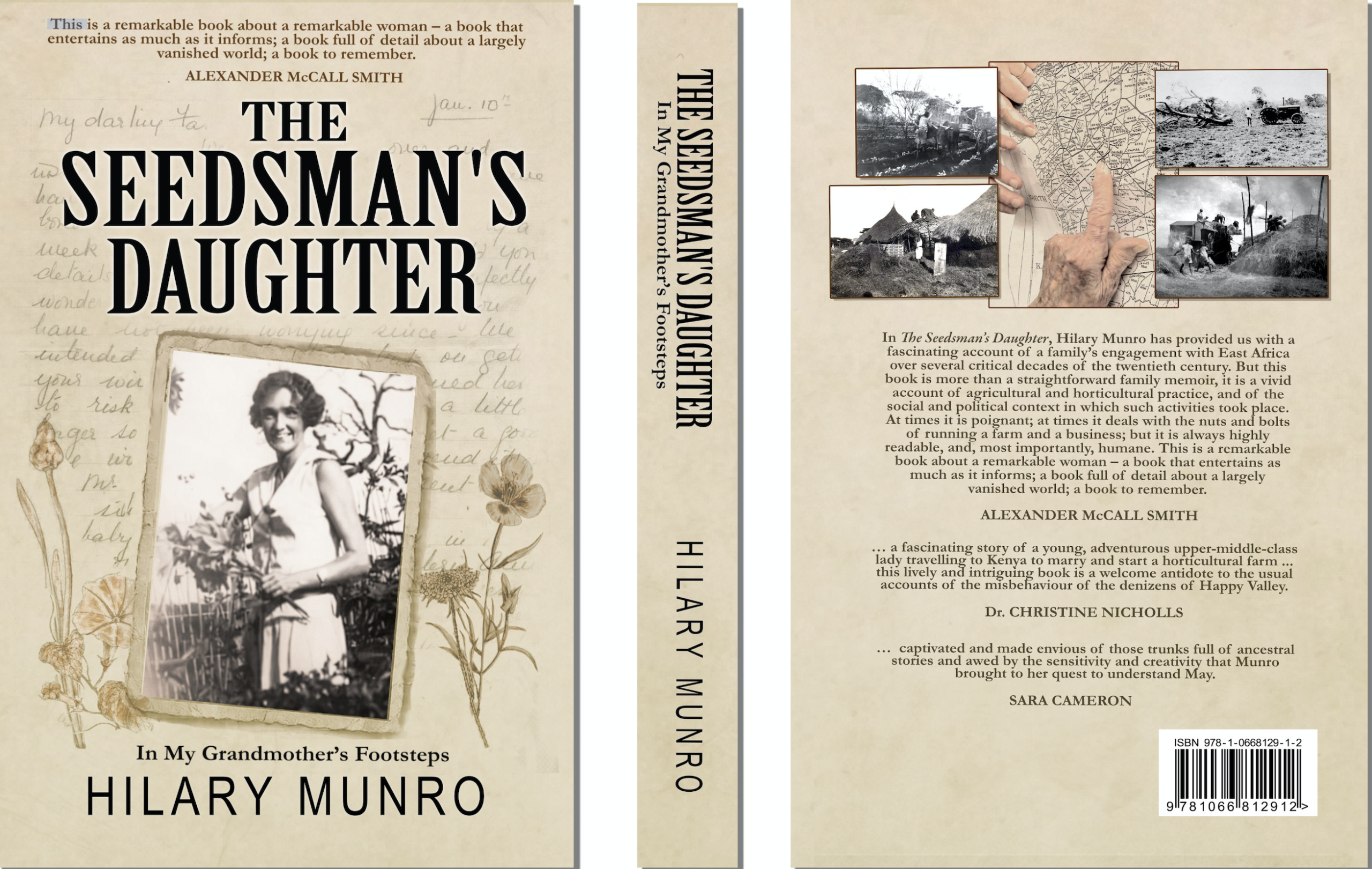
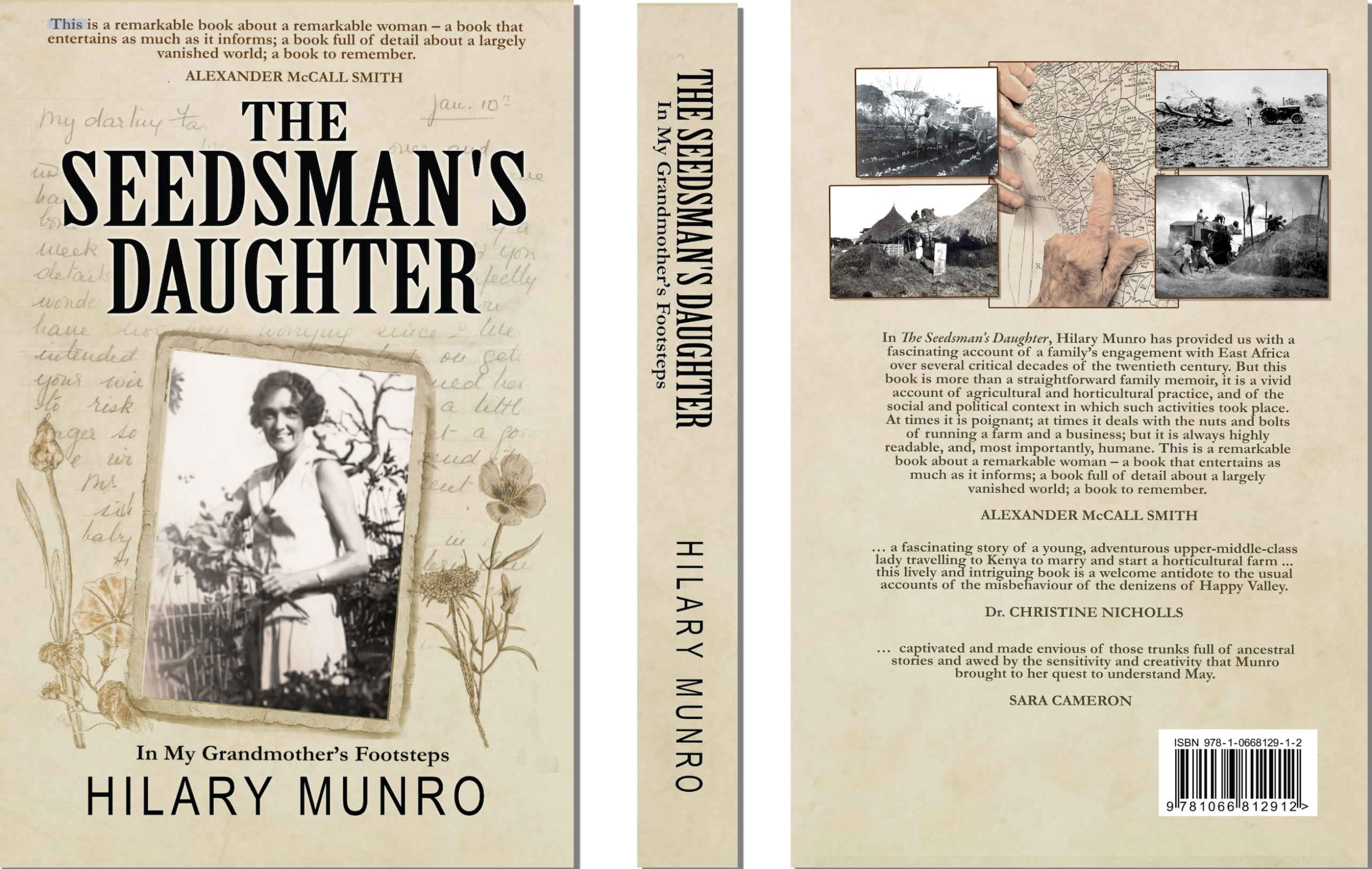
In The Seedsman’s Daughter, Hilary Munro has provided us with a fascinating account of a family’s engagement with East Africa over several critical decades of the twentieth century. But this book is more than a straightforward family memoir, it is a vivid account of agricultural and horticultural practice, and of the social and political context in which such activities took place. At times it is poignant; at times it deals with the nuts and bolts of running a farm and a business; but it is always highly readable, and, most importantly, humane. This is a remarkable book about a remarkable woman – a book that entertains as much as it informs; a book full of detail about a largely vanished world; a book to remember.
Alexander McCall Smith
This is the story of a granddaughter’s discovery of family letters and papers in boxes in an attic. It begins with an account of the Sutton family and Sutton’s Seeds, the death of four Sutton sons in the First World War, and the marriage of their sister May to Fred Chater-Jack, a young man whom she followed to Kenya to marry. Here we have a detailed account of the pair’s struggles to build their house and develop their farms, of experiments with the planting of Sutton’s Seeds near Mt Elgon, some of which worked and others failed, of endeavours to market their horticultural produce, of the seeming impossibility of acquiring a good English nanny for their children, and of the eventual shooting of their nanny by Fred. Then there was bankruptcy and a return to England in 1939.
The letters from May and Fred are extensively quoted. They give a vivid picture of Kenya in the 1920s and 1930s, particularly in the Eldoret/Kitale area. The stresses of trying to make a living (their farms never made a profit), the remoteness and loneliness and reliance on neighbouring farmers for a social life, the disappointments and the triumphs – all are here. In this pre-email and digital age the long, descriptive letters from May and Fred are a godsend to anyone who wishes to read a rollicking good story from a century ago.
Christine Nicholls, former editor of the Dictionary of National Biography, notable books: Elspeth Huxley: A biography, Red Strangers: The White Tribe of Kenya
In Hilary Munro’s extraordinary and beautifully written story of her family, we are immediately captured by her enigmatic grandmother May. Here is a woman who is at once austere, unemotional and timetabled – tea is always at four, sherry drunk at six. Yet to Munro’s utter surprise, the discovery of a rich trove of family histories, also reveals May as courageous, flirtatious, loving and a woman of her time.
Early on, while the loss of four brothers in the Great War is clearly never far from her mind, May embarks on an essential quest for a husband. Mindful of the dire shortage of men after the war, and the appalling prospect of being left on the shelf, May rightly gambles on a trip to the romantic and fashionable Swiss resort of Murren. She calculates that the fittest, most intrepid and eligible men will be attracted to the downhill races and she is not disappointed. This is 1923. Carrying the appropriate social pedigree, and barely chaperoned, May comes dressed to seduce, wearing the latest most daring flapper fashions. She happily collides with the eminently suitable Fred Charter-Jack who is also in need of a wife. They soon snag each other and head off for an intrepid and at times tragic life on Fred’s farm, in Kitale, Kenya colony. May is extraordinarily suited for farm life, coming as she does from the renowned Sutton Seeds family. Horticulture is in her genes and so is a dose of rebellion. May, as Munro discovers, was also descended from a line of unusual adventure-seeking women.
Munro happily pulls us into a remarkable reconstruction of May’s life. Like her we want to know what changed her grandmother from that gay, adventurous flapper girl into the severe woman that Munro knew as a child. She brings the story to life not only through that extraordinary treasure trove of memorabilia, photographs and letters that were discovered in unopened chests in her aunt’s attic. (This is a family that sometimes exchanged and preserved letters even while living in the same house!) To this, Munro adds meticulous research into the times of May’s life that may have shaped her experience and her own journeys to the places that May travelled, to see the sights she saw. This reader was both captivated and made envious of those trunks full of ancestral stories and awed by the sensitivity and creativity that Munro brought to her quest to understand May. Like the author, by the end of the tale, we feel enlightened.
Sara Cameron, author Natural Enemies, winner Turner Tomorrow Award
The Seedman’s Daughter is not available until 3rd October 2026. To preorder from Amazon,