Kurdistan – the other Iraq: Day two

Somewhat surprising this morning, the Kurdish bodyguard and driver greeted me in English with an excellent Portsmouth accent! His family had fled the violence in Kirkuk to the safety of the Kurdish enclave, but he and his brother went to the UK. He chose to go to Portsmouth. There he saw the sea for the first time and went to see it most evenings after work in a factory in Havant.

Eleven years later he has returned to an unrecognisable city: buildings are going up everywhere. He misses the sea, the rain and the greenness.

There is certainly money and optimism for the future underpinned by a feeling of safety, tinged with worry what the new year will bring when the American troops withdraw from Southern Iraq.

Seeking safety, this place is full of refugees from all over Iraq, as well as others seeking better wages and conditions than they have at home from countries such as Pakistan, Bangladesh, Biafra, Egypt, India, Sudan, Sri Lanka and Albania. The barista in the coffee shop spoke no Kurdish and little Arabic – his English was good though.

Near the centre around the base of the Citadel and the side streets are small shop units and a covered souk selling everything needed for the home and life – no tourist tat here. The active fruit and vegetable market bustles with men and women buying from barrows, a scene replicated all over the Middle East – but no burqas or niquabs anywhere. Men sit in the central square café with Hookah and coffee in the late autumn sun.

There is no sense of any personal security issues, I attracted no attention at all. A good measure of the safety of a place anywhere is whether women and children are around. In Erbil, apart from the cafe, they fill the souk, the street market, the shops and the pavements.

Older men wear blouse type shirts and wide trousers tucked into narrow bands at the ankle. A wide piece of embroidered material catches the shirt and trouser top in the middle. Now the days grow cooler, a dark jerkin is worn atop. Younger men adopt casual styles similar to ‘the West’, though I note that drainpipe ultra tight trousers tend to be shiny. Women wear black full length gallibeya, but with bright notes and designs and all wear headscarves.

Posted in Uncategorized | Tagged , , | Leave a comment

Surviving the Sights and Souks


more…

published in The Chronicle, September 2011, Cairo

Posted in The Chronicle | Tagged , , | Leave a comment

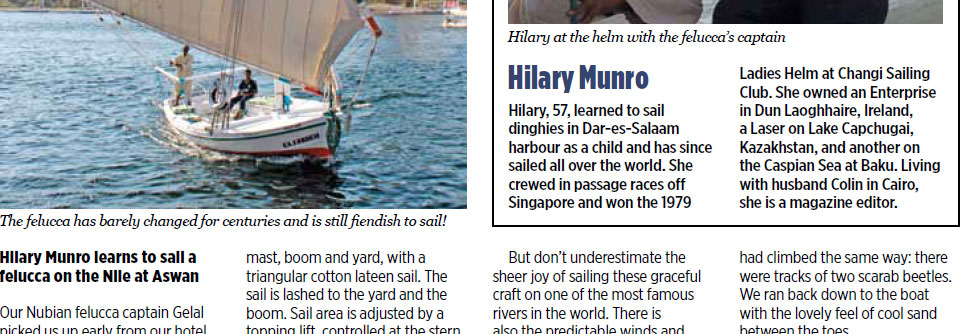
Winter sun in an ancient craft


more…

published in Yachting Monthly October 2011, UK

Posted in International Press | Tagged , , , | Leave a comment

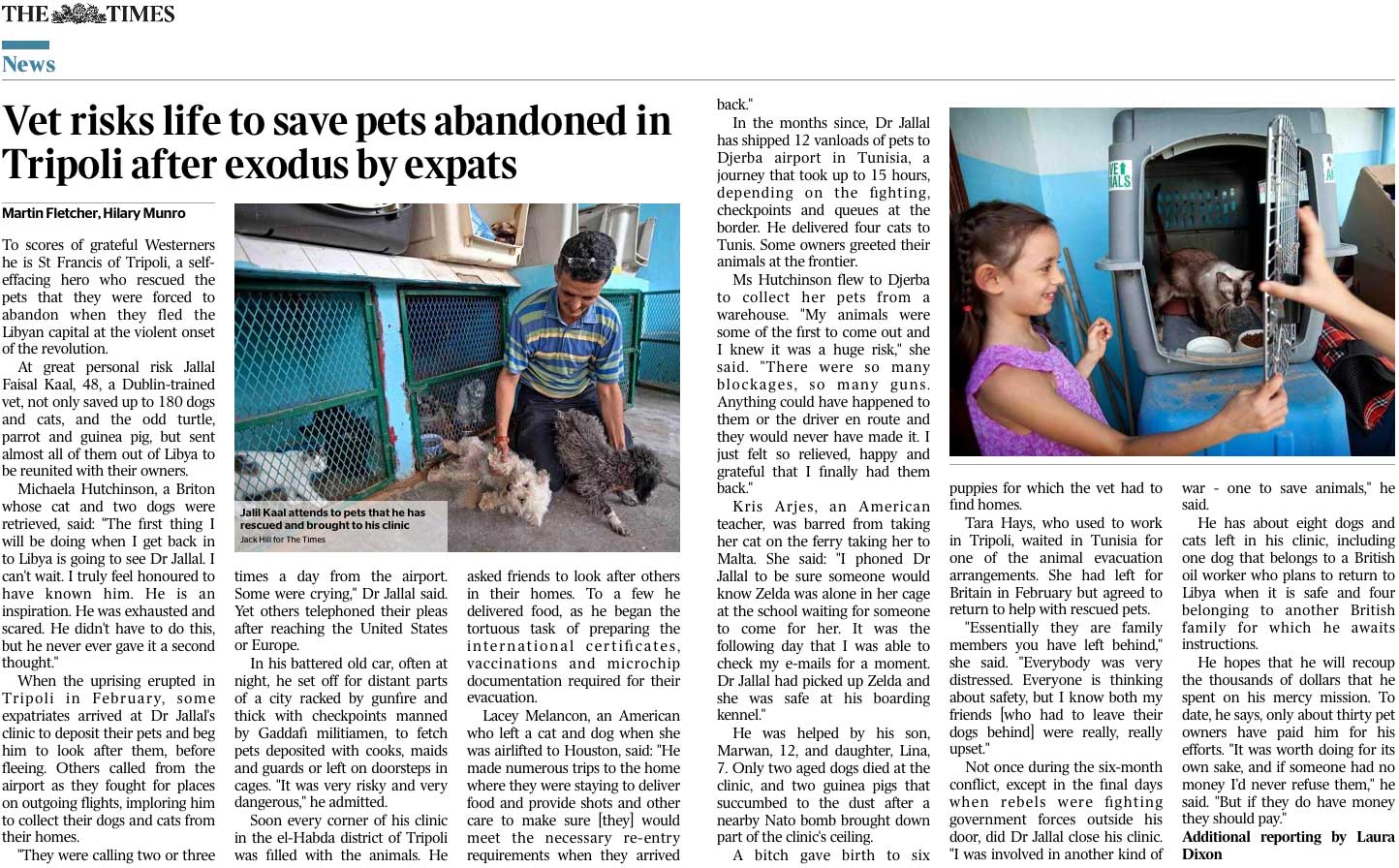
Vet risks life


more…

published in The Times, September 3rd 2011, UK

Posted in The Times | Tagged , , | Leave a comment

Libya 2011 is not Iraq 2003

Iraq 2003 is not the template of Libya 2011. Apart from both being headed by two remarkably nasty dictators, there is almost no similarity between the ‘liberation’ of Iraq and the current liberation of Libya.

The defining difference is that liberation was imposed by US led coalition army on Iraq.

True there is a distinct rumble of boots on the ground, and there is a decisive intervention by NATO, but the uprising was started by a spontaneous uprising in Benghazi, continued by a rag-tag army of undisciplined civilians and now headed by the NTC, a Libyan group that were not appointed by foreigners.

True also that the historic UN resolution (with five abstentions, but in themselves historic abstentions) to assist the opposition group in Libya ‘to protect civilians’ has been somewhat disingenuously stretched by NATO.

This one significant event is either completely ignored in the flurry of articles worrying that Libya will descend into ‘post liberation’ Iraq sectarian chaos, or the actions of NATO are assumed to be equivalent to the invasion of Iraq in 2003 –see today’s articles (23/08/2011) “Averting chaos of another Iraq is next task for allies” The Times, and “Libya analysis: An Iraq repeat can be avoided”  The Mirror or http://www.juancole.com/2011/08/top-ten-myths-about-the-libya-war.html

However, without this foreign assistance, there can be no doubt that the opposition would have been ruthlessly crushed.  The gassing of thousands of Iraqi Kurds and marsh Arabs under Saddam Hussein’s regime was the spectre before Benghazi and Misurata.

Despite pleas from Iraqi opposition, the International community were not united enough to support it. Thus when the Coalition army did finally enter Iraq there was no effective opposition left.

Therefore, since there was no government in waiting, the Americans lead the transition through a coalition council of appointed 25 – 30 Iraqis.   And the reconstruction was spear-headed by largely American companies.

Conversely in Libya, there is an opposition government, which has been effectively running liberated areas since last February.

Another significant dissimilarity: the Iraqis can be Sunnis, Shia, Christian and Bahai.  Libyans are all Sunni.

It would be most surprising if free Libya did not have a rocky road.  The maverick Ghadafi smashed most of Libya’s infrastructure: many cities and roads have been destroyed and people traumatised in this uprising.

Whatever happens next though,  the Libyan reconstruction is not the next task for the ‘allies’.   It is the next task – for the Libyans using any expertise that they choose to employ, foreign or otherwise.  Their choices may not be those that other countries would make,  but those choices will be their own.  Not wrong, but different.

Whilst it remains to be seen that if the TNC can step up to effectively manage the transition to a new Libya, it has had a few months to learn some of the ropes.  Benghazi and other areas in rebel control are being administered; the police and army are being trained and are graduating, hospitals and schools are open.

Libya also has some trump cards in the pack, which should give hope to its people that there will be a free Libya to enjoy – and make many a country envious:

  • The oil and gas industry, on which the reconstruction of Libya depends, does have a strong infrastructure continued from King Idris’ times and can therefore be up and running fast;
  • A significant number of Libyans are graduates from universities abroad.  The strong family ties will ensure that many will return to help with the reconstruction.
  • Libya does not have a grandfathered national debt.
Posted in Uncategorized | Tagged , , , , , , | Comments Off on Libya 2011 is not Iraq 2003

Mango Season

The competition in the garden escalated unexpectedly this morning.  I had thought that the race was between the guards, the part time gardener, us, the bats, and the ants.

I was not surprised that the part-time gardener was more attentive and came in earlier every morning, and that the security guards were doing their rounds more often round the house. This close attention happened last year at this time.

I knew we had to be quick off the mark, if we were running short in the house, to be in the race with any chance.

I had not realised though that the tortoise, a longer resident than us in this house, was also a competitor.  This morning there she/he was, on the grass, clearly enjoying a mango.

Day and night from now until the end of September will be punctuated by the steady thump of falling fruit.  It is only the start of the season and the trees are laden.

Today there were a dozen mangoes to share between the guard, the taxi-driver whose pitch starts near our gate, and us – not counting the one for the tortoise!  By next week we can widen our list to include others.


Posted in Uncategorized | Tagged , , , , | Comments Off on Mango Season

Death on Cairo’s streets

Last night, Adil, the eight-year-old son of Mustafa, the gardener who tends many of the gardens in this neighborhood, was killed by a truck whilst playing in the street outside his home.

A quiet serious child with a lovely smile; Adil often came with his father and played in our garden.

A tragic addition to the officially estimated 8,000 people who die annually on Egypt’s road (2010 survey released by the Interior Ministry).   A number contested by the Cairo based Arab Road Association, which puts the real number of accidents as exceeding 125,000.

This is the reality of Cairo, Egypt, a city the size of Greater London with an overflowing population.  There are almost no public green spaces for children to play in, and sidewalks and pedestrian overpasses are a rarity.  Children must play in the streets and everyone must walk on the overcrowded roads.

In a dense neighborhood of high-rises nearby there is one small green patch with flowering bushes and trees.  At night it is full to bursting with women and children picnicking and playing.  Cars, lorries and motorbikes, jostling noisily, completely encircle this happy scene.

There are no walkways to this green inner circle.  Four major roads spit out their honking belching cargo unceasingly.  There are no opportunities to cross safely.  Women and children weave, running, across the road.

According to the Egyptian Transport Ministry less than 1% of drivers stop for pedestrians.

An AUC student 2010 survey found that 30% of truck and trailer drivers tested positive for drug use, and 70% of all fatalities occur to pedestrians, because of an insufficient number of crosswalks and pedestrian overpasses.

A Transport Committee Report (2011) called for a national media campaign to highlight the loss of life and personal cost; emphasise its negative impact on the national economy and tourism;  spread awareness of the traffic laws and road safety, amend and improve the traffic laws;  and ‘educate the traffic police on the traffic laws and duty to enforce the laws’ (!).

But there are adequate traffic laws – but only perhaps 20% are enforced.  The police are badly paid and poorly educated, many are unable to read or write, and ‘tips’ (bribes) are considered normal.  Driving licenses can be bought, and trucks and taxis are not only unroadworthy but also the drivers can drive 18 hours a day.

Not surprisingly, Egyptian roads compete for the dubious honour of being the most dangerous in the world.


Posted in Uncategorized | Tagged , , , , | Comments Off on Death on Cairo’s streets

A day out in Aswan


more…

published in The Chronicle, Cairo. June 2011 Issue

Posted in The Chronicle | Leave a comment

Road Security, Sinai

We drove from Cairo to St Catherine’s in The Sinai a few days ago and experienced a bit of why the emergency laws are so hated – police checkpoints checked and rechecked our documents and car documents at every town and road junction from the Suez tunnel onwards over  the +200km distance.

Our driver told us that Egyptians couldn’t go to The Sinai by air or road without employment papers or proved hotel reservations according to laws put in place when Sinai was returned by Israel to Egypt some 30 years ago.

We stopped for lunch at the half-way point where beach gave way to high mountains tumbling into the sea and two soldiers hiked over from a hut to ask for our ID – we hadn’t realised it was a checkpoint.  The friendly soldiers told us that they were are conscripts who spend most of their 3 years assigned to this checkpoint guarding the coastline.

It’s hard to see what from: other bathers? The nearest town was only 2 km along the coast – with a checkpoint on the road.

Posted in Uncategorized | Tagged , , | Comments Off on Road Security, Sinai

A Libyan perspective

The revolution is not over in Egypt,  and all the objectives are not yet realised and may well not be, but Egyptians are rightly proud of the way that the 25th January revolution was conducted.

A foreign news reporter friend of mine who covered the whole period in Tahrir Square said that it was one of three best events he had covered in his long career.   His next assignment was Tripoli, followed by Benghazi.

I met him in a hotel bar on his way back from Benghazi a week ago.  ‘How did the Libyan experience compare’? I wanted to know.  This is what he said:

Tripoli two months ago is very different to the city now.  Then he could slip the minder and get into Zawiyah through back roads, and find Libyans in opposition – but he could see that it put them in danger, the security men moved in fast and ominously.  Now journalists there are confined to the hotel, unless heavily escorted to pre-selected places.

The conflict in Libya is nastier.  Increasingly the rebels are taking prisoners and giving hospital treatment to regime soldiers,  but it was not always the case.  Emotions understandably run high with deaths of old people, women and children from grad rockets fired into homes and snipers deliberately targeting – especially in Misrata.

The most attractive trait he treasured though was the honesty, generosity and,  strange to say, innocence of the Libyans he met in Benghazi.   Somewhat isolated from the world in these decades, there is little world-weariness and cynicism.   They have a taste of freedom in their mouth and they want to savour it for the rest of their lives and those of their children.

Current events in the Middle east demonstrate that indeed the Egyptians (and Tunisians) have much be be proud of.   Other regimes though perhaps take note that the departing president and their families are being called to account now.


Posted in Uncategorized | Tagged , , , , | Comments Off on A Libyan perspective